
Students are asked to watch a video clip and then document respectful communication on a graphic organiser.
- Plan the formative assessment
- Design the formative assessment
- Collect evidence
- Analyse and interpret evidence
- Make responsive decisions

Achievement standard:
By the end of Year 8, students analyse factors that influence identities, emotions and responses to change, and describe strategies to respond to these influences. They analyse how stereotypes, respect, empathy and valuing diversity influence relationships. Students analyse the effectiveness of assertive communication strategies, protective behaviours and help-seeking strategies applied online and offline. They analyse health information and messages to propose strategies that enhance their own and others’ health, safety, relationships and wellbeing. Students apply and transfer movement skills and movement concepts across a range of situations. They implement and evaluate the effectiveness of movement strategies on movement outcomes. Students propose and evaluate strategies designed to achieve personal health, fitness and wellbeing outcomes. They select, use and refine strategies to support inclusion, fair play and collaboration across a range of movement contexts.
Content description:
explain and apply skills and strategies to communicate assertively and respectfully when seeking, giving or denying consent
Content learnt before:
describe strategies for seeking, giving or denying consent and rehearse how to communicate their intentions effectively and respectfully
Content learnt next:
examine how strategies, such as communicating choices, seeking, giving and denying consent, and expressing opinions and needs can support the development of respectful relationships, including sexual relationships


Formative focus
Can students explain how to communicate respectfully when seeking, giving and denying consent?
Summary of the formative assessment
This graphic organisers formative assessment provides evidence of students’ ability to explain how to communicate respectfully when seeking, giving and denying consent.
This formative assessment provides insight into how students understand and interpret respectful communication and consent in a social context. Using a graphic organiser, students identified and explained moments from the Little Lunch clip. This allowed the teacher to see how students recognized respectful and disrespectful behaviours, and justified their thinking using evidence.
Summary of the class in which this assessment was implemented
This formative assessment was implemented in a Year 7–8 class at a point in the learning sequence where students were developing their understanding of consent and respectful communication in relationships. All students in the class were working towards this same learning goal.
Explore the assessment:
Consent is given freely and not under any form of pressure. After watching the clip from Little Lunch titled Kiss Chasey, students identify and explain moments of respectful communication using a graphic organiser.
Used with permission from Australian Children’s Television Foundation
Little Lunch, Series 1, Episode 9, Kiss Chasey.
© 2015 Little Lunch Holdings Pty Ltd, Screen Australia and Film Victoria
Annotation
1. A digital graphic organiser was prepared to capture students’ thinking about respectful communication in the clip. It supported students to identify examples, explain their reasoning and use evidence to justify their ideas. Students were given the option to complete the organiser in different ways, including written, digital or dictated responses. All students chose to digitally record their answers using the online template.

Formative focus
Can students explain how to communicate respectfully when seeking, giving and denying consent?
Data collection summary:
Student interpretations of respectful communication based on the Little Lunch clip were captured digitally. These responses represented groups of similar responses, and were reviewed and confirmed by the teacher. This allowed the teacher to compare how students interpreted consent, respectful communication and character interactions across the class.
When reviewing the groups of student responses, the teacher could see a clear range in how students understood respectful communication.
- Some students were able to identify specific moments from the clip and explain why the communication was respectful or not, using relevant evidence.
- Others could identify examples but gave more general explanations.
- Some responses suggested misconceptions, particularly around recognising when someone’s “no” was not respected.
The teacher was careful not to rely only on the written responses in the graphic organiser.
- For some students, the organiser did not fully reflect their understanding. The teacher followed this up by asking selected students to explain their thinking verbally, using the same guiding questions from the task. For example, did Battie want to play, how did Tamara respond and how could respectful communication have been shown?
- In these cases, students could explain their ideas more clearly in discussion than in writing. This helped the teacher distinguish between students who needed support with understanding respectful communication and those who understood the concept but needed support to express their thinking more clearly.
Understand the data record:
Student responses showed how they identify respectful and disrespectful behaviours, explain character actions and justify their thinking, using evidence from the clip.
The patterns across responses showed a clear range in understanding. Some students provided clear explanations supported by evidence. Others gave more general responses or showed misconceptions about consent and respectful communication.
Follow-up questioning confirmed that, for some students, the graphic organiser did not fully reflect their understanding. The teacher asked students to explain their thinking verbally, using the same guiding questions from the task. These students were then able to demonstrate clearer understanding than in their written responses. This indicated that the primary challenge for these students was communicating their thinking, rather than understanding respectful communication.
These samples illustrate a range of responses across the class. Three samples show that students can identify and describe respectful communication, with varying levels of detail and use of evidence. One sample highlights a need for further support to develop understanding of respectful communication.
Inferences about these students:
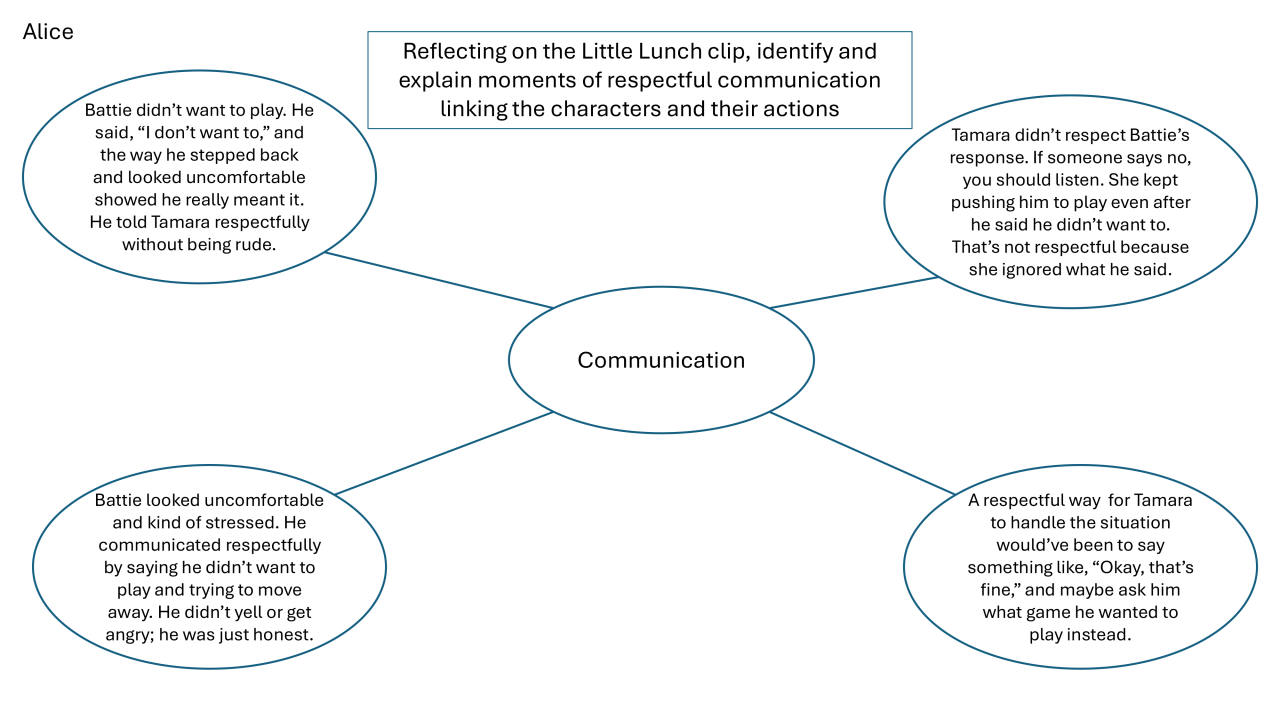
Alice demonstrates a clear understanding and can articulate instances of respectful communication, using evidence from the clip.
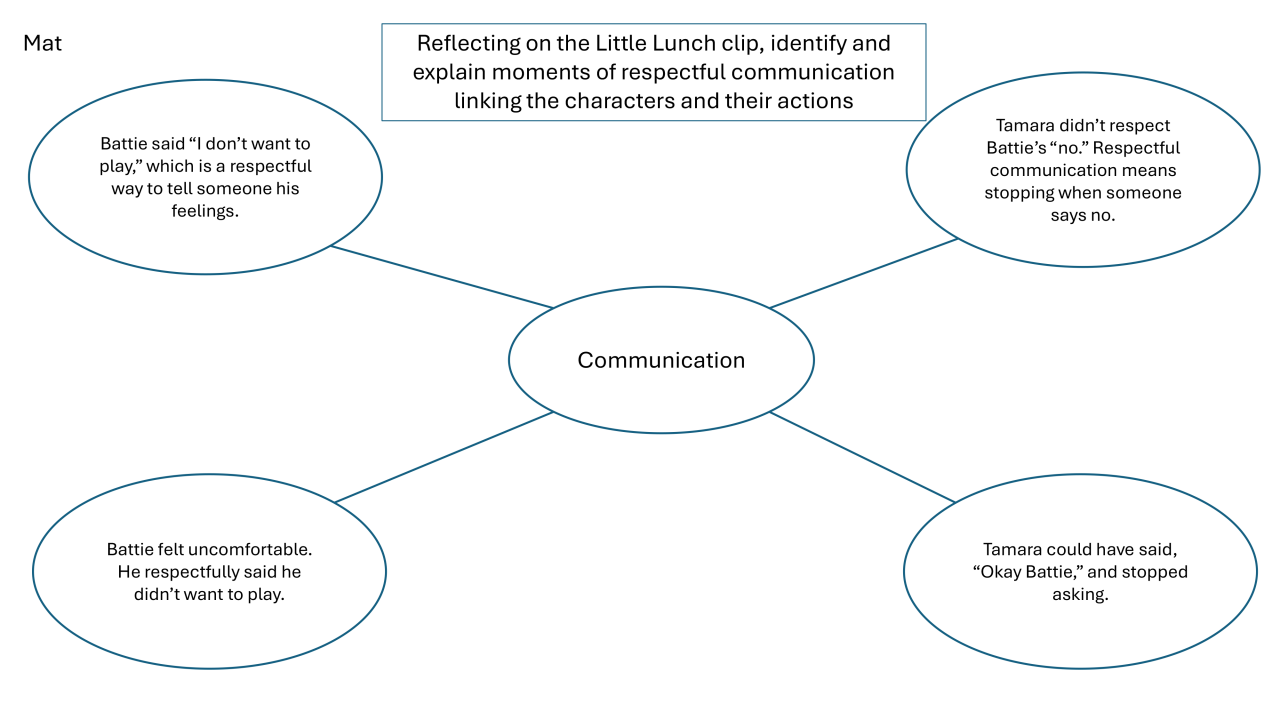
Mat demonstrates an emerging understanding of respectful communication and is beginning to explain thinking, using examples from the clip.
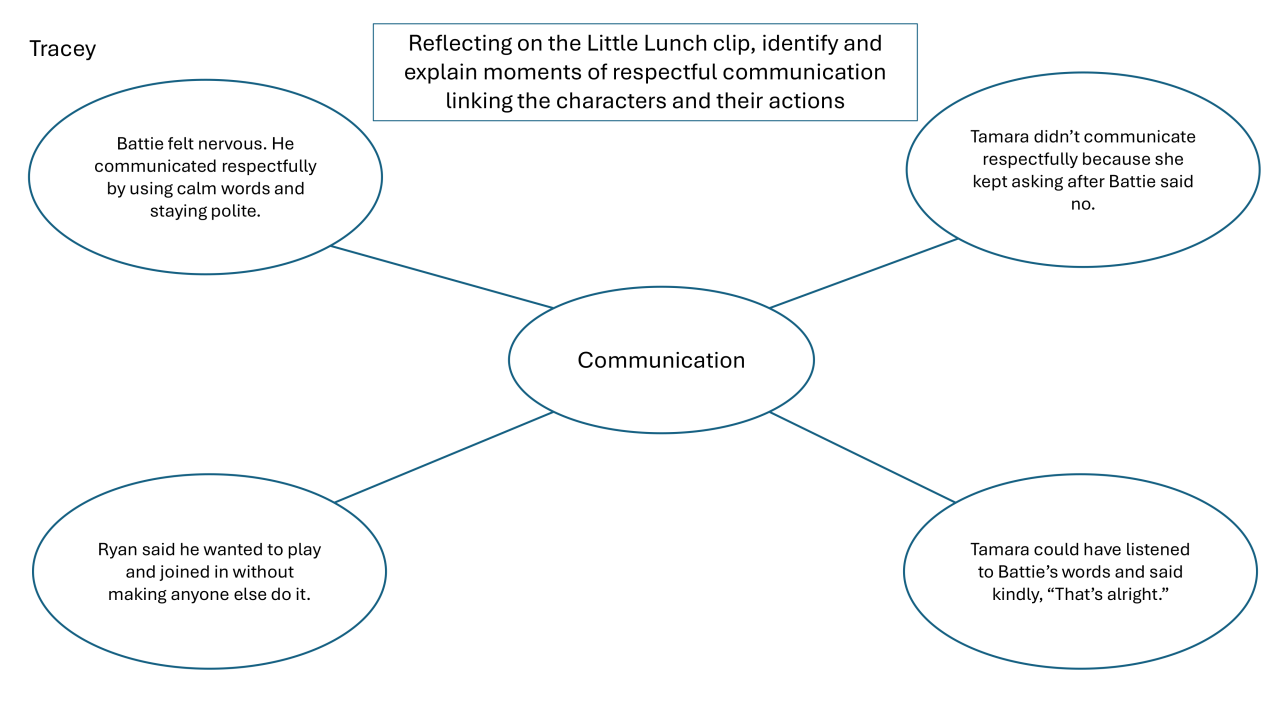
Tracey demonstrates developing understanding and is working on expressing ideas clearly in writing.
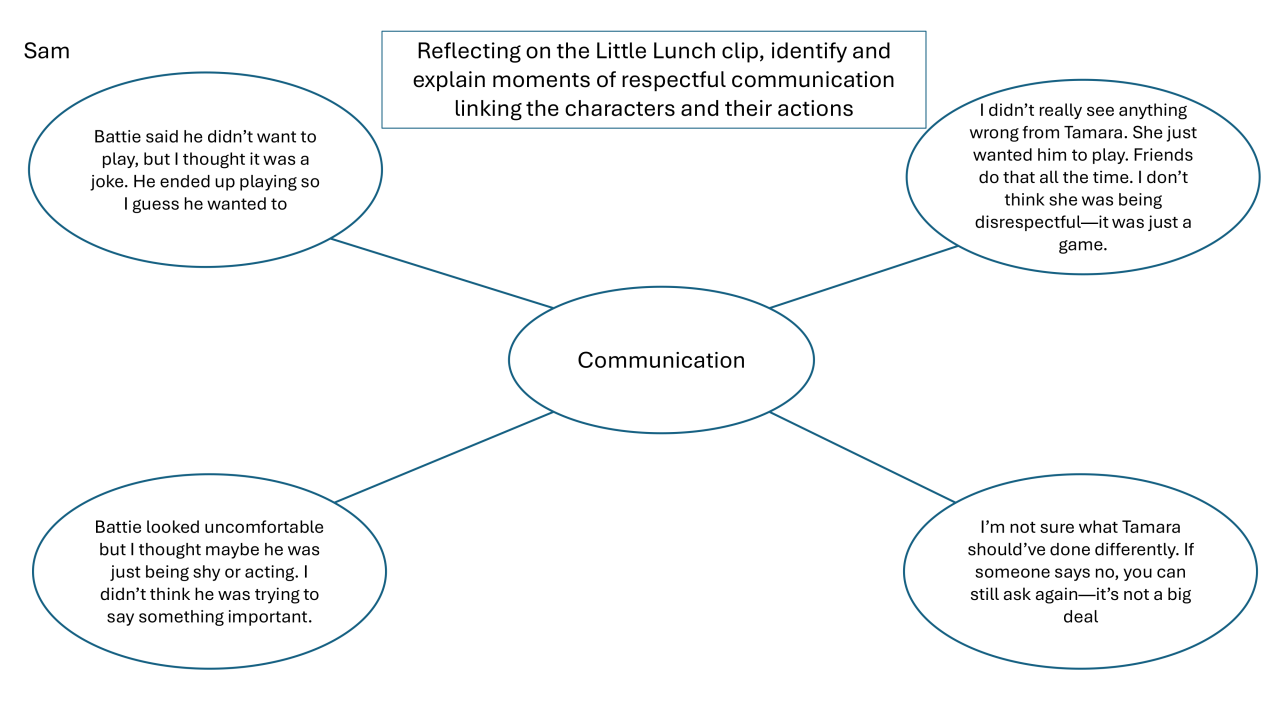
Sam’s response suggests developing understanding and includes possible misconceptions about respectful communication that require clarification.

Formative focus
Can students explain how to communicate respectfully when seeking, giving and denying consent?
Explaining next steps
This formative assessment was used during learning to uncover how students understand and interpret respectful communication and consent. The task focused on connected aspects of the same idea, including recognising respectful and disrespectful behaviours, interpreting character actions and explaining responses.
Based on patterns in student responses, the next steps are organised around 2 groups of learners (students who can and students who are yet to), rather than individual moments from the clip.
The suggestions below can be used flexibly in whole-class, small-group or targeted support to respond directly to what students have shown.