
The formative assessment design framework helps teachers create purposeful, practical and curriculum-aligned formative assessments through a process of informed decision-making.
- Design framework
- Design guides
The formative assessment design framework helps teachers create curriculum-aligned formative assessment through a structured way of thinking about formative assessment design. It is built around 4 key components of formative assessment design.
Using the framework components as a design process, teachers work through guiding prompts that help them make decisions that align the assessment to the intention of the curriculum. Based on those decisions, the design tool recommends suitable formative assessment types. Teachers then select the option that best fits their formative focus, class context and student needs.
The process is supported by design guides, which help teachers tailor the chosen formative assessment type for different classrooms, learning areas or subjects. Teachers then consider what is being assessed, who their learners are and the learning context to ensure the assessment is purposeful, practical and aligned with the Australian Curriculum.
This process shows how curriculum, evidence and responsive teaching connect to improve student learning.
Formative assessment is a powerful tool for improving student learning.
The formative assessment design framework helps teachers create curriculum-aligned formative assessment through a clear and structured way of thinking about formative assessment design.
The design framework uses four components, formative focus, aim, timing, and evidence.
Using these components as a design process teachers work through guiding questions that help them define what they want to assess, why and when evidence will be most useful, and how to collect it.
Based on these decisions the design tool recommends suitable formative assessment types which teachers then select and tailor to their class context and student needs.
Component one is formative focus.
Teachers begin by identifying the aspect of a content description that will be the focus of the formative assessment.
Content descriptions set out the specific learning that contributes to students’ progression toward the achievement standard, which is why formative assessment is designed at this level.
Component two is aim.
Here teachers clarify the why of the formative assessment. They focus on one key question: What do I need to know about my students' learning?
Selecting an aim category identifies the specific insight that will guide the next instructional step.
Component three is timing.
The effective and efficient use of formative assessment depends not only on what and why, but also when assessment is implemented.
Teachers decide when evidence will be most useful before teaching, during the lesson, after learning to plan the next lesson, or across the learning sequence.
Component four is evidence.
Teachers consider what evidence will show whether students can demonstrate the learning identified in the formative focus, while remaining actionable and manageable.
This decision is shaped by practical factors like available time and subject frequency.
Decisions made across the four components lead to 10 formative assessment types.
These are the practical outputs of the framework, giving teachers a suitable list of assessments they can select, adapt, and use in their classrooms.
A design guide for each type helps teachers tailor the chosen formative assessment type for different classrooms, learning areas or subjects.
Together these four components give teachers a clear pathway from the curriculum to their classroom, ensuring formative assessments are purposeful, practical, and aligned with the curriculum, teaching and student learning goals.
Explore the full formative assessment design framework and resources on the Australian Curriculum website.
Formative focus
Specifies the aspect of the curriculum content description to be assessed, guiding the direction of the formative assessment.
Aim
Clarifies the specific purpose of conducting the assessment.
Timing
Specifies when the assessment will occur within the teaching.
Evidence
Determines the form of data collected to monitor student learning.
Components of formative design
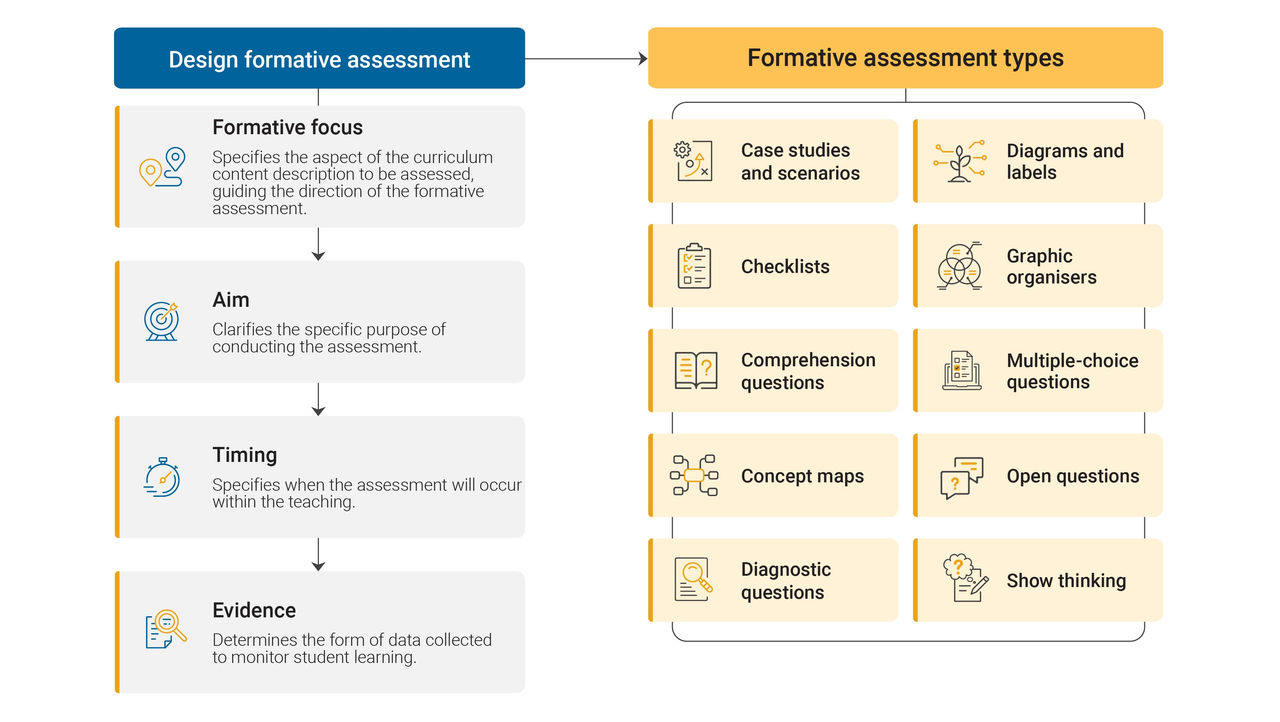
Figure 1. Components of formative assessment design outlining key elements such as formative focus, aim, timing, evidence, and assessment types
Formative assessment design process
Use the design tool below to select a suitable formative assessment type.
The design process starts by identifying an aspect of a curriculum content description for formative assessment, known as the formative focus. The formative focus answers the question: “What is the specific focus of the learning that I want to gather formative data about?”
In the video, a content description is used to show how to identify the formative focus. The questionnaire tool and supporting resources also step out this process.
This video walks teachers through the first component of the formative assessment design framework, formative focus.
A formative focus is developed from a content description within a teacher’s planned lesson sequence.
Teachers identify the aspect of a content description that will be the focus for the formative assessment.
Content descriptions set out the specific learning that contributes to students’ progression toward the achievement standard, which is why formative assessment is designed at this level.
Assessing a specific aspect of a content description provides clear evidence of students’ current learning and what to teach next.
There are four steps that guide teachers to define a formative focus.
Step 1. Identify the thinking
2. Choose the learning focus
3. Clarify the curriculum language
4. Confirm where students are starting.
Let's look at an example from Year 1 Algebra.
The content description says recognise, continue, and create repeating patterns with numbers, symbols, shapes, and objects, identifying the repeating unit.
Step 1 is to identify the thinking students are expected to demonstrate.
In a content description, the thinking required is usually indicated by verbs such as identify or apply.
In this description, the verbs are recognise, continue, identify, and create.
These indicate a progression.
Students first recognise and continue patterns, then identify the repeating unit and finally create their own.
For a formative focus, we'll begin with the first two verbs, recognise and continue, as the thinking required.
Step 2 is choose the learning focus.
Teachers identify the specific aspect of content students will apply their thinking to.
Here, the Year 1 content emphasis is on repeating patterns and the repeating unit.
For this formative assessment, we'll focus on repeating patterns.
In step 3, it's time to clarify the curriculum language.
Teachers review the key terms and concepts to confirm what the curriculum intends for this year or band.
Key terms here include repeating patterns, repeating unit, numbers, symbols, shapes and objects.
In Year 1, students move from repeating patterns with shapes and objects to those with symbols and eventually with numbers.
To keep the formative assessment manageable, we'll narrow this to symbols, shapes, and objects.
Step 4 is confirm where students are starting.
In this final step, teachers check whether students are beginning new learning or building on curriculum previously taught.
This content continues from Foundation, where students recognised, copied, and continued repeating patterns.
In Year 1, formative assessment can be used to check that this learning is consolidated before introducing the new expectation of identifying the repeating unit and creating repeating patterns.
With the four steps complete, the formative focus we arrive at is: Can my students recognise and continue repeating patterns with symbols, shapes, and objects?
By working through these steps, teachers can define a clear formative focus. This becomes the foundation for designing formative assessment that is purposeful, practical, and aligned with the curriculum.
Begin by defining formative focus
Step 1: Identify the thinking
In a content description, the thinking required is usually indicated by verbs such as “identify” or “apply”. Select a focus for students to demonstrate.
Step 2: Choose the learning focus
Identify the specific aspect of content students will apply their thinking to.
Step 3: Clarify the curriculum language
Review the key terms and concepts to confirm what the curriculum intends for this year or band.
Step 4: Confirm where students are starting
Check whether students are beginning new learning or building on curriculum previously taught.
Supporting documentation
Design guides help teachers to tailor the chosen formative assessment type for different classrooms, learning areas or subjects. Teachers then consider what is being assessed, who their learners are and the learning context, to ensure the assessment is purposeful, practical, and curriculum-aligned.
Any formative assessment can fit into one of 10 foundational types. Each type is designed to help teachers make curriculum-aligned, purpose driven decisions that gather meaningful evidence of student learning in flexible and adaptable ways. While not an exhaustive list, these assessment types give teachers a dependable and adaptable starting point for assessment design, representing the range of techniques widely used in classroom practice. They help teachers make informed decisions to align assessments with the Australian Curriculum.
The list of assessment types adapts to the specific decisions made through the design framework. The suitable assessment types generated through the framework ensure that the evidence collected matches the formative focus, intended aim and chosen timing of the assessment. Above all, these assessment types are intended to be practical and adaptable, enabling teachers to use them flexibly and responsively to guide their next instructional steps.