
Students are asked to describe the effects of First Nations Australians’ technological achievements on land and water management and daily life.
- Plan the formative assessment
- Design the formative assessment
- Collect evidence
- Analyse and interpret evidence
- Make responsive decisions

Achievement standard:
By the end of Year 7, students describe the historical significance of the ancient past and the histories of early First Nations Peoples of Australia. They identify the causes and effects of events, developments and achievements connected to groups and individuals in Australia and other societies from the ancient past. Students describe the social, religious, cultural, economic, environmental and/or political aspects related to changes and continuities in these societies. They identify the roles and achievements of significant individuals and groups, and the influences on the development of ancient societies. Students explain the importance of heritage sites connected to Australia and other societies from the ancient past.
Students develop questions about the past. They locate and identify primary and secondary sources as evidence in historical inquiry. They describe the origin, content, context and purpose of primary and secondary sources. Students identify the accuracy and usefulness of sources as evidence. They sequence events and developments to describe causes and effects, and continuities and changes across societies and periods of time. They describe the perspectives, attitudes and values of the past in sources. They identify and describe historical interpretations about significant events and people. Students use historical knowledge, concepts, terms and evidence from sources to create descriptions, explanations and historical arguments.
Content learnt before:
sustainable use and management of renewable and non-renewable resources, including the custodial responsibility First Nations
Australians have for Country/Place
the influence of people, including First Nations Australians and people in other countries, on the characteristics of a place
present descriptions and explanations, drawing ideas, findings and viewpoints from sources, and using relevant terms and conventions
Content learnt next:
the causes and effects of European contact and extension of settlement, including their impact on the First Nations Peoples of Australia
continuities and changes and their effects on ways of life and living conditions, political and legal institutions, and cultural expression around the turn of the 20th century in Australian society
create descriptions, explanations and historical arguments, using historical knowledge, concepts and terms that incorporate and acknowledge evidence from sources


Formative focus
Can students describe the effects of First Nations Australians’ technological achievements on daily life, land and water source management?
Summary of the formative assessment
This concept maps formative assessment gives teachers a quick snapshot of how students understand the causal relationship between First Nations Australians’ technological achievements and daily life, land and water source management. Teachers will identify individuals or small groups of students with gaps in knowledge and misconceptions who need follow-up learning.
Summary of the class in which this assessment was implemented
The class had been learning about the Deep time history of Australia. This includes the arrival of early First Nations Australians on the Australian continent, their social organisation and how First Nations Australians have responded to environmental processes and changes over time in their local area. Students had been building their skills around History, including historical perspectives and interpretations. They were developing their understanding of how different First Nations Australians groups applied innovative thinking in relation to their specific Place or Country and that not all technological achievements are present across all First Nations Australians groups.
Explore the assessment:
Annotation
1. Students were given the concept map template.
2. Students brainstormed technological achievements as a class.
3. Students completed a short concept map about effects of First Nations Australians’ technological achievements. First, they categorised these technological achievements into one of 3 categories: daily life, land management, water source management. Next, students described the effects these achievements had within the category.

Formative focus
Can students describe the effects of First Nations Australians’ technological achievements on daily life, land and water source management?
Data collection summary:
Understand the data record:
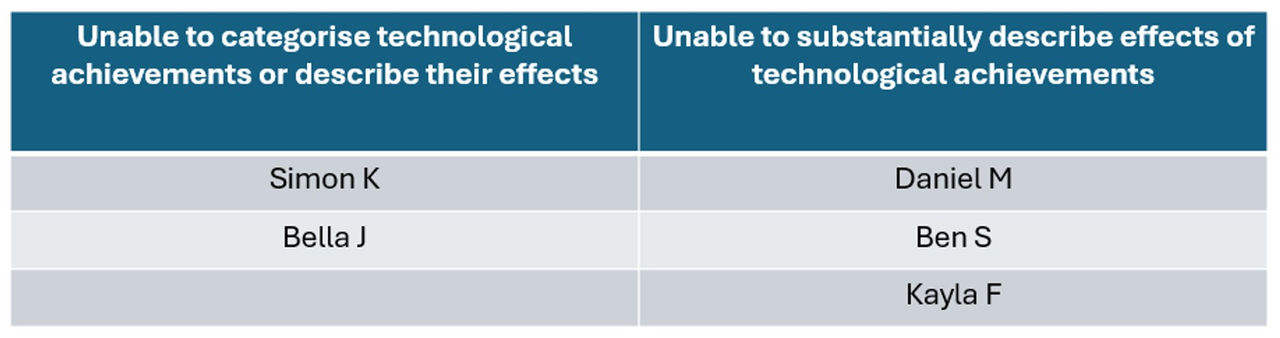
The teacher recorded the names of students who were unable to categorise the technological achievements independently or describe their effects.
The teacher recorded the names of students who were unable to substantially describe the effects of technological achievements.
Inferences about these students:
- Most students easily categorised the technological achievements. Most students could describe the effects; however, to varying levels of detail.
- Overall, the level of detail was reduced in the daily life category. After a quick clarification or discussion, students were able to develop their responses in this category.
- 2 students are identified as needing significant support.
- 3 students are identified as needing minor intervention or reteaching before moving forward.

Formative focus
Can students describe the effects of First Nations Australians’ technological achievements on daily life, land and water source management?
Explaining next steps
Students continue to progress through learning of Deep time history of Australia, including social organisation and cultural practices of early First Nations Australians. Students apply a range of skills to support their historical perspectives and interpretations.